

Beyond Blind Trust: When Confident AI Advice Overrides Human Judgment
—The Selective Obedience Paradox
Author
Humna Nadeem
Software Engineering Student | Researcher
ABSTRACT
The growing influence of artificial intelligence (AI) in decision-making raises concerns about whether confidently presented AI advice can cause individuals to override their own judgments, even when the advice is incorrect. This study examines this issue through the concept of the Selective Obedience Paradox, in which individuals retain independent judgment in most situations but may not sufficiently distinguish between accurate and inaccurate AI advice when they choose to rely on it. A total of N=50 participants completed five decision-making tasks, producing 250 decision opportunities. Participants changed their initial answers in 61 cases 24.4%, including 31 cases 12.4% in which they changed specifically to follow AI advice. Of these AI-following cases, 16 (51.6%) involved incorrect recommendations. Participants who followed AI also reported lower mean initial confidence 3.03/5 than those who did not 3.93/5. The findings suggest that AI influence is selective rather than automatic and highlight the importance of evaluating not only how often individuals follow AI, but whether their reliance is appropriately aligned with recommendation accuracy.
Index Terms
Index Terms—Artificial intelligence, human–AI interaction, algorithmic advice, selective obedience, automation bias, AI reliance, human judgment, calibrated trust.
I. INTRODUCTION
Artificial intelligence (AI) is increasingly embedded in decision-making processes that require human judgment. Beyond functioning as a computational or information-retrieval tool, AI is now used to recommend answers, evaluate alternatives, and influence final decisions. This shift creates a behavioral challenge: the value of AI depends not only on the accuracy of its recommendations but also on whether human users can determine when those recommendations should be accepted, questioned, or rejected.
Research on algorithmic advice shows that human responses to AI are neither uniform nor predictable. Algorithm appreciation describes situations in which individuals give substantial weight to algorithmic recommendations, whereas algorithm aversion reflects reluctance to rely on algorithms, particularly after observing errors [1], [2]. Research on automation bias further shows that individuals may sometimes rely excessively on automated advice, although such reliance is neither inevitable nor universal [3]. Recent work also indicates that users can overrely on AI recommendations even when those recommendations conflict with available information or their own assessment [4]. These findings suggest that the central issue is not simply whether people trust AI, but when and under what conditions AI advice influences them to revise their own judgment.
This question becomes particularly significant when an individual has already formed an initial judgment before receiving AI advice. Revising that judgment may be beneficial when AI corrects an inaccurate response. The same process, however, can reduce decision quality when an initially correct judgment is replaced by an incorrect recommendation. Simple measures of agreement with AI therefore provide an incomplete basis for evaluating human–AI decision-making. AI-following may improve decision accuracy, reduce it, or simply reinforce an answer that was already correct.
The present study examines this distinction through the concept of the Selective Obedience Paradox. The term is used to describe a pattern in which individuals may retain independent judgment across many decision situations while still showing potentially inappropriate reliance when they choose to defer to AI advice. The concern is therefore not continuous or automatic obedience to AI, but whether moments of AI reliance are sufficiently aligned with the accuracy of the recommendation.
This pattern may also be associated with confidence in one's own judgment and the perceived authority of AI advice. Confidently presented recommendations may act as signals of certainty or competence, particularly when individuals are uncertain about their initial decisions. Previous research has similarly suggested that confidence in one's own judgment can influence whether individuals accept or reject AI recommendations [5]. The present study, however, does not test the causal effect of AI confidence. Because all recommendations were presented confidently and no low-confidence comparison condition was included, the study examines responses to confidently presented AI advice rather than establishing confidence itself as the cause of judgment revision.
The study involved (N = 50) participants who completed five decision-making tasks, producing (250) decision opportunities. Participants first provided an independent response and reported their confidence in that judgment. They were then exposed to a confidently presented AI recommendation and given an opportunity to revise their answer. This design enabled the study to distinguish between general judgment revisions, changes made specifically to follow AI advice, and whether the adopted AI recommendation was correct or incorrect.
The study addresses the following research questions:
RQ1: To what extent does exposure to confidently presented AI advice lead individuals to revise their initial judgments?
RQ2: When participants revise their judgments to follow AI advice, how often does this reliance involve correct versus incorrect AI recommendations?
RQ3: Is lower measured confidence in an individual's initial judgment associated with a greater willingness to follow confidently presented AI advice?
RQ4: How do participants describe their willingness to trust, verify, or reject confidently presented AI recommendations?
The central contribution of this study is the distinction between the frequency and the quality of AI-following. Rather than measuring only whether participants accepted AI recommendations, the study examines whether following AI was associated with correct or incorrect decision outcomes. This distinction provides a more precise basis for evaluating whether AI reliance reflects beneficial decision support or potential overreliance.
As AI becomes increasingly integrated into everyday decision environments, the challenge is not simply to increase or decrease trust in technology. Effective human–AI collaboration requires calibrated reliance: the ability to benefit from accurate AI recommendations while maintaining sufficient critical judgment to question those that may be incorrect. The present study examines this challenge at a critical stage of decision-making—the point at which an individual considers abandoning an existing judgment in favor of confidently presented AI advice.
II. LITERATURE REVIEW AND RELATED WORK
A. Algorithmic Advice, Authority, and Human Reliance
As AI systems increasingly participate in human decision-making, their influence depends not only on their computational capability but also on the extent to which users treat their recommendations as authoritative. Research on algorithmic advice has identified two contrasting tendencies. Algorithm appreciation describes situations in which individuals give substantial weight to algorithmic recommendations and may rely on them more than equivalent human advice [1]. In contrast, algorithm aversion refers to reluctance to rely on automated advice, particularly after users observe an algorithm making errors [2].
These findings demonstrate that human responses to AI are not uniformly characterized by either trust or resistance. Reliance on algorithmic advice appears to depend on multiple factors, including perceived competence, prior experience, task characteristics, and the decision-maker's own confidence. The growing role of AI in judgment therefore raises a broader question concerning algorithmic authority: under what conditions do individuals allow machine-generated recommendations to influence or replace their own judgments? Research on algorithmic advice supports the view that AI influence should be understood as a behavioral process rather than simply a consequence of algorithmic accuracy [1], [2].
B. Automation Bias, Selective Adherence, and the Selective Obedience Paradox
A closely related concept is automation bias, which refers to inappropriate reliance on automated recommendations despite contradictory information or warning signals. Automation bias raises particular concerns when individuals reduce independent evaluation and allow automated output to substitute for their own judgment. However, evidence suggests that algorithmic adherence is not universal. Alon-Barkat and Busuioc found no general tendency for participants to follow algorithmic advice more than equivalent human advice, while also demonstrating that adherence can be selective and shaped by specific contextual conditions [3].
This distinction is important because the absence of constant AI-following does not necessarily indicate appropriately calibrated reliance. Individuals may reject AI recommendations in many situations but still defer to them under particular conditions. Recent experimental research similarly shows that users can overrely on AI advice even when it conflicts with available contextual information and their own assessment, producing detrimental decision outcomes [4].
The present study builds on this literature by distinguishing between correct and incorrect AI-following. Existing measures of agreement do not necessarily indicate whether reliance on AI improves or reduces decision quality. Examining the accuracy of the recommendation followed therefore provides a more precise basis for evaluating whether AI reliance reflects beneficial decision support or potential overreliance.
C. Human Confidence and Appropriate Reliance on AI
Confidence in one's own judgment is another important factor in AI-assisted decision-making. Individuals who are uncertain about an initial decision may be more willing to reconsider that decision after receiving external advice. Chong et al. found that human self-confidence plays a significant role in determining whether individuals accept or reject AI suggestions, with self-confidence having a stronger influence on adoption decisions than confidence in the AI itself [5]. Their findings further demonstrate that human–AI interaction can affect users' confidence and potentially contribute to continued reliance on poorly performing systems.
This perspective is particularly relevant when AI advice is presented confidently. A decisive and authoritative recommendation may provide an apparent source of certainty when individuals are uncertain about their own judgment. However, confidence in presentation does not necessarily indicate accuracy. The present study therefore focuses on the behavioral relationship between confidently presented AI advice, participants' measured initial confidence, and subsequent decision revision. Because AI confidence was not experimentally manipulated, the study does not claim that confidence itself independently causes AI-following.
Taken together, the literature suggests that effective human–AI collaboration requires more than simply increasing or decreasing trust in AI. The central requirement is appropriate or calibrated reliance: users should be able to accept AI recommendations when they are reliable while maintaining sufficient independent judgment to reject them when they are inaccurate. The present study contributes to this literature by explicitly distinguishing between following correct AI advice and following incorrect AI advice. This distinction provides the theoretical basis for examining whether AI reliance reflects beneficial decision support or potential accuracy-insensitive reliance, forming the central empirical basis of the Selective Obedience Paradox.
III. METHODOLOGY
A. Participants and Study Profile
The study involved N = 50 participants who completed a structured decision-making survey examining responses to confidently presented AI recommendations. Each participant completed five decision-making tasks, producing a total of:
50 times 5 = 250 decision opportunities.
The study employed a repeated-measures design in which participants made an initial judgment, reported their confidence in that judgment, received an AI recommendation presented confidently, and subsequently provided a final response. This design enabled the study to examine changes in judgment within participants across multiple decision situations rather than relying on a single response.
The participant group was primarily composed of young adults and undergraduate students with varying levels of familiarity and experience with AI tools. These characteristics provide contextual information about the sample but were not treated as independently manipulated variables.
TABLE I
PARTICIPANT AND STUDY PROFILE
Characteristic | Result |
Total participants | N = 50 |
Participants aged 18 –25 | 39 |
Other adult age categories | 10 |
Participants under 18 | 1 |
Undergraduate students | 42 |
Other/postgraduate education categories | 8 |
Participants frequently or often using AI tools | 35 |
Participants occasionally using AI tools | 14 |
Decision-making tasks per participant | 5 |
Total decision opportunities | 250 |
The sample therefore consisted largely of participants from a younger and academically active population with prior exposure to AI technologies. This context is relevant because familiarity with AI may shape how individuals interpret algorithmic recommendations. However, the present study does not treat demographic characteristics or AI familiarity as independent causal predictors of AI reliance.
B. Survey Instrument and Decision Architecture
The survey instrument was designed to capture the behavioral process through which an independently formed human judgment may be influenced by subsequent AI advice. The five decision-making tasks covered different forms of reasoning and general knowledge, allowing AI influence to be observed across multiple decision opportunities.
Each task followed the same general sequence:
Initial Judgment -> Initial Confidence ->Confident AI Recommendation -> Final Judgment
Participants first provided an answer without AI assistance. They then reported their confidence in their initial judgment using a 5-point rating scale. After the initial response and confidence rating had been recorded, participants were shown an AI recommendation presented with a confident framing. Participants subsequently had the opportunity to reconsider their original answer and provide a final response.
The survey also included attitudinal questions examining participants' broader responses to AI advice, including their willingness to verify AI-generated information, their tendency to reconsider an answer when AI appeared highly confident, and their preference for retaining their own judgment.
This instrument structure allowed the study to distinguish between initial human judgment, confidence in that judgment, and subsequent behavioral responses to AI advice.
C. AI Advice Exposure and Judgment-Revision Procedure
The central procedure examined whether participants retained or revised their independently formed judgments after exposure to confidently presented AI recommendations. The initial and final responses for each task were compared to identify changes in decision-making behavior.
A judgment change was recorded when a participant's final answer differed from the initial answer. AI-following was recorded when a participant changed the initial answer specifically to match the AI recommendation.
AI-following cases were further classified according to the accuracy of the recommendation. This distinction produced two analytically different outcomes:
Correct AI-following and Incorrect AI-following
This classification was central to the study because agreement with AI alone does not indicate whether AI influence improved or reduced decision quality. A participant may benefit from following a correct recommendation or experience a decline in decision accuracy after following an incorrect one. The analysis therefore focused not only on the frequency with which participants followed AI but also on whether their reliance was aligned with the accuracy of the recommendation.
All AI recommendations in the experimental tasks were presented confidently. Consequently, the study examined how participants responded to confidently presented AI advice, rather than experimentally comparing high-confidence and low-confidence AI conditions. The design therefore supports examination of the association between exposure to confident AI advice and judgment revision but does not isolate the independent causal effect of confidence itself.
In addition to the questionnaire, informal verbal conversations were conducted with a substantial subset of participants to obtain supplementary insight into participants' reactions to AI recommendations. These conversations explored participants' confidence in their own answers, willingness to reconsider their judgments, and attitudes toward AI-generated advice. The interview observations were not formally coded as a qualitative dataset and were therefore treated as exploratory contextual evidence rather than independent statistical findings.
Overall, the methodological design captured the following behavioral sequence:
Independent Judgment -> Confidence -> Confident AI Advice -> Judgment Retention or Revision
This procedure enabled the study to examine whether participants retained or revised their initial judgments after receiving AI advice, whether judgment revisions involved direct AI-following, and whether the adopted AI recommendations were correct or incorrect .
IV. EMPIRICAL RESULTS AND FINDINGS
This section reports the empirical findings from the five decision-making tasks completed by 50 participants. Across the experiment, each participant was exposed to AI recommendations after providing an initial judgment and confidence rating, resulting in 250 decision opportunities. Rather than treating all post-AI changes as equivalent, the analysis distinguishes between general judgment revision, direct AI-following, the accuracy of the adopted AI recommendation, initial confidence, task-level changes in accuracy, and participants' stated preferences toward verification. This distinction is important because a change in judgment does not necessarily indicate reliance on AI, and reliance on AI does not necessarily indicate improved decision quality.
A. Judgment Revision Following Confident AI Advice
Across the 250 decision opportunities, participants retained their initial judgment in 189 cases (75.6%) and revised it in 61 cases (24.4%) after receiving the AI recommendation. Thus, although the majority of initial judgments remained unchanged, nearly one in four decision opportunities resulted in a post-AI revision.
TABLE II
OVERALL JUDGMENT OUTCOMES AFTER AI EXPOSURE
Judgment Outcome | Frequency | Percentage |
|---|---|---|
| Initial judgment retained | 189 | 75.6% |
| Initial judgment changed | 61 | 24.4% |
| Total | 250 | 100% |
The result provides an important baseline for understanding AI influence. The data do not support the interpretation that participants automatically accepted AI advice. Instead, participants generally maintained their original judgments , although a substantial minority of decision opportunities resulted in revision . Consequently, the relevant question is not simply whether AI changed human judgment, but what happened in the cases where judgment changed.
B. From Judgment Revision to AI-Following
The 61 judgment revisions were examined further to determine whether the participant changed the original answer specifically to match the AI recommendation. Of these revisions, 31 cases involved direct AI-following, while the remaining 30 changes did not directly correspond to the AI recommendation.
Therefore, direct AI-following occurred in 31 of the 250 decision opportunities, representing 12.4% of the complete dataset. Importantly, AI-following accounted for approximately half of all observed judgment revisions (31 of 61 cases; 50.8%).
TABLE III
DISTINGUISHING JUDGMENT REVISION FROM AI-FOLLOWING
Behavioral Outcome | Frequency | Percentage of All Opportunities |
|---|---|---|
| Initial judgment retained | 189 | 75.6% |
| Judgment changed after AI exposure | 61 | 24.4% |
| Changed specifically to follow AI | 31 | 12.4% |
| Changed without directly following AI | 30 | 12.0% |
| Total | 250 | 100% |
This distinction reveals that AI influence represented a specific form of judgment revision rather than the explanation for every change observed after AI exposure. At the same time, the fact that approximately half of all revisions involved direct AI-following indicates that the AI recommendation was behaviorally relevant in a substantial portion of the cases in which participants reconsidered their initial judgment.
C. Accuracy of AI-Following
The most important empirical pattern emerged when the 31 AI-following cases were examined according to the correctness of the adopted recommendation that participants adopted. Participants followed a correct AI recommendation in 15 cases (48.4%) and an incorrect AI recommendation in 16 cases (51.6%).
TABLE IV
ACCURACY OF AI RECOMMENDATIONS FOLLOWED
Type of AI Recommendation Followed | Frequency | Percentage of AI-Following Cases |
|---|---|---|
| Correct AI recommendation | 15 | 48.4% |
| Incorrect AI recommendation | 16 | 51.6% |
| Total AI-following cases | 31 | 100% |
Percentages are calculated among the 31 cases in which participants changed their answer to match the AI recommendation.
This finding is central to the research question because it shows that the occurrence of AI-following alone does not establish beneficial reliance. Within the observed AI-following cases, incorrect recommendations were followed slightly more frequently than correct recommendations. In other words, participants did not restrict their reliance exclusively to recommendations that were correct.
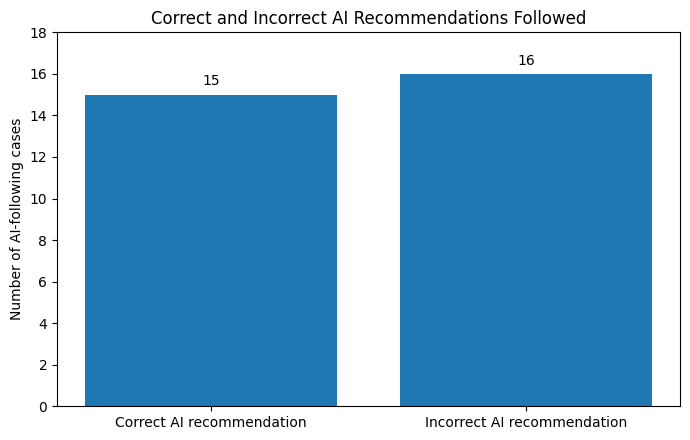
Fig. 1. Distribution of correct and incorrect AI recommendations followed by participants.
The result does not demonstrate that participants were generally irrational or that AI was generally harmful. Rather, it identifies a more specific problem: once participants decided to rely on AI, their reliance was not consistently aligned with the correctness of the recommendation they adopted. This distinction forms the empirical basis for the Selective Obedience Paradox developed in the discussion.
D. Initial Confidence and AI-Following
Initial confidence provided an additional perspective on when participants were more likely to reconsider their judgments. Across all decision opportunities, the mean initial confidence was 3.82 on a five-point scale. However, decision opportunities that subsequently resulted in AI-following had a lower mean initial confidence of 3.03/5, compared with 3.93/5 for decision opportunities in which participants did not follow AI.
TABLE V
INITIAL CONFIDENCE AND SUBSEQUENT AI-FOLLOWING
Decision Outcome | Mean Initial Confidence |
|---|---|
| Overall | 3.82/5 |
| AI-following cases | 3.03/5 |
| Non-following cases | 3.93/5 |
| Observed difference | 0.90 points |
The observed 0.90-point difference is consistent with a descriptive association between lower initial confidence and subsequent AI-following within the observed data. Participants were, on average, less confident in the judgments that they later replaced with the AI recommendation.
This finding adds an important qualification to the central result. AI influence was not distributed uniformly across all decisions. Participants appeared more willing to reconsider judgments in which their initial confidence was comparatively lower. However, because confidence was measured rather than experimentally manipulated, and because each participant contributed multiple decision opportunities, the observed difference should be interpreted as an association rather than evidence that lower confidence caused AI-following.
More importantly, lower confidence does not by itself guarantee appropriate reliance. Even within the cases where participants reconsidered their judgment and followed AI, both correct and incorrect recommendations were adopted. Thus, confidence appears relevant to when participants became receptive to AI, but the present data do not establish that confidence alone determined whether that reliance was accurate.
E. Task-Level Accuracy Changes
The effect of AI exposure was not uniform across the five decision-making tasks. Final accuracy increased relative to initial accuracy in Tasks 1, 2, 4, and 5, whereas Task 3 showed a decrease in the number of correct responses, from 32 before AI exposure to 27 after AI exposure.
TABLE V
TASK-LEVEL CHANGES IN DECISION ACCURACY
Task | Initial-to-Final Accuracy Direction |
|---|---|
| Task 1 | Increased |
| Task 2 | Increased |
| Task 3 | Decreased: 32 → 27 |
| Task 4 | Increased |
| Task 5 | Increased |
The task-level pattern is important because it demonstrates that AI exposure did not produce a single uniform outcome across all decision contexts. Four tasks moved in the direction of higher final accuracy, while one task moved in the opposite direction.
Task 3 is particularly noteworthy because the number of correct responses declined from 32 to 27 following AI exposure. This observation shows that, within the present dataset, lower final accuracy occurred in at least one task following exposure to the AI recommendation. However, the present study does not establish that the AI recommendation caused the decline, since the design and available analysis do not isolate a causal effect of AI exposure.
Taken together, the task-level findings suggest that the value of AI assistance may depend on the interaction between the recommendation, the decision context, and the participant's initial judgment. This reinforces the need to evaluate AI reliance at the level of decision quality rather than assuming that additional AI involvement necessarily produces better outcomes.
F. Participant Attitudes Towards Verification and AI Advice
The behavioral findings were complemented by participants' reported attitudes toward confidently presented AI advice. Twenty participants (40%) indicated that they preferred to review or verify AI-provided information before making a final decision. Fifteen participants (30%) reported that they would be more likely to change their answer when the AI appeared highly confident because they considered the recommendation more likely to be correct. Eight participants (16%) preferred to retain their own judgment, while four participants (8%) selected multiple responses and three participants (6%) provided no response.
TABLE VII
PARTICIPANT ATTITUDES TOWARD CONFIDENT AI ADVICE
Reported Response | Participants | Percentage |
|---|---|---|
| Prefer to verify AI information | 20 | 40% |
| More likely to change when AI appears highly confident | 15 | 30% |
| Prefer to retain own judgment | 8 | 16% |
| Multiple responses selected | 4 | 8% |
| No response | 3 | 6% |
| Total | 50 | 100% |
The responses reveal an important tension between participants' stated intentions and the behavioral findings. Verification was the most frequently reported preference, suggesting that many participants recognized the need for critical evaluation of AI-generated information. At the same time, 30% reported greater willingness to change their answer when the AI appeared highly confident.
This contrast is relevant because the behavioral data demonstrate that AI-following did not consistently correspond to correct recommendations. Consequently, a general intention to verify AI output may not necessarily translate into verification at the precise moment when a participant is deciding whether to override an existing judgment. The questionnaire results therefore provide contextual evidence for the behavioral findings, but they should not be treated as direct measurements of actual verification behavior .
V. DISCUSSION
The findings provide a clear but nuanced view of how individuals respond to confidently presented AI advice. Participants retained their initial judgments in most decision opportunities, showing that AI did not produce automatic compliance. However, when participants changed their answers, a substantial proportion directly followed the AI recommendation. Importantly, these AI-following cases were almost evenly divided between correct and incorrect recommendations. This suggests that the key challenge is not whether people trust AI, but whether their reliance is appropriately calibrated to the reliability of its advice.
A. The Selective Obedience Paradox
The central finding is the distinction between AI-following frequency and AI-following quality. Participants followed AI in 31 of 250 decision opportunities (12.4%), but 16 of these cases involved incorrect recommendations. Thus, reliance on AI was selective rather than automatic, yet selection did not consistently correspond to recommendation accuracy.
This pattern motivates the concept of the Selective Obedience Paradox: individuals may remain independent in most decisions while still accepting unreliable AI advice when they choose to rely on it. This extends previous work on algorithmic reliance and selective adherence [3 by emphasizing not only whether AI is followed, but whether the followed recommendation is correct.
B. Confidence and AI Reliance
AI-following decisions had lower mean initial confidence (3.03/5) than non-following decisions (3.93/5), indicating that participants were more receptive to AI when they were less certain about their own judgments. However, both correct and incorrect AI recommendations were followed. Therefore, lower confidence may be associated with greater openness to AI, but it does not guarantee appropriate reliance.
This finding highlights an important distinction between confidence and reliability. A confidently presented AI response may appear authoritative, but presentation confidence should not be treated as evidence of correctness.
C. Reliance Versus Appropriate Reliance
The near-even split between correct and incorrect AI-following demonstrates that reliance alone is an incomplete measure of successful human–AI interaction. Following a correct recommendation may improve a decision, whereas following an incorrect recommendation may reduce decision quality. Recent research similarly shows that excessive reliance on AI can produce decision costs when users accept inappropriate recommendations [3].
Accordingly, effective human–AI decision-making should aim for calibrated reliance, rather than maximum trust or maximum skepticism.
D. Implications for Human–AI Systems
The findings support the design of AI systems that encourage verification rather than passive acceptance. AI interfaces should clearly communicate uncertainty, provide supporting evidence where possible, and avoid presenting confidence as a substitute for reliability. Human oversight is particularly important at the point where users consider replacing their own judgment with an AI recommendation.
AI literacy should therefore focus not only on understanding AI capabilities but also on recognizing the difference between persuasive confidence and actual reliability.
E. Limitations and Future Research
This study provides exploratory evidence based on 50 participants and five decision-making tasks. The analysis is primarily descriptive and does not establish causal relationships. In particular, confidence was measured rather than experimentally manipulated, and all AI recommendations were presented confidently.
Future studies should experimentally vary AI confidence, recommendation accuracy, task difficulty, and user confidence. Larger and more diverse samples would also improve generalizability. Such research can further determine when AI reliance becomes beneficial, harmful, or appropriately calibrated.
Overall, the findings suggest that the goal of human–AI interaction should not be to make people trust AI more or less, but to help them trust it appropriately.
VI. RECOMMENDATIONS & RISK MITIGATION
The findings indicate that effective human–AI decision-making depends on the quality of reliance rather than on simply increasing or reducing trust in AI. Risk-mitigation strategies should therefore support users in evaluating AI recommendations according to their reliability, available evidence, and decision context.
A. Promote Accuracy-Sensitive Reliance
AI systems should be designed to encourage users to evaluate recommendations based on their reliability rather than their presentation alone. Interfaces should distinguish between confidence and correctness, making clear that a highly confident recommendation is not necessarily an accurate one.
B. Reduce the Persuasive Effect of Uncalibrated Confidence
Confident language or certainty cues should be aligned with demonstrated system reliability. Excessive or unjustified confidence may encourage users to override their own judgments without sufficient evidence. AI interfaces should therefore avoid presenting confidence as an implicit guarantee of correctness.
C. Introduce Verification for Conflicting Decisions
When an AI recommendation conflicts with a user's initial judgment—particularly when the user has high confidence in that judgment—the system should encourage a brief verification step rather than immediately promoting acceptance. This can reduce inappropriate judgment override while preserving the benefits of valid AI assistance.
D. Train Users for Calibrated AI Use
User training should move beyond the simple instruction to “trust AI” or “be skeptical of AI.” Users should instead learn to accept accurate recommendations, question uncertain recommendations, and independently verify recommendations when evidence conflicts. Such training can support calibrated reliance without encouraging either algorithm aversion or automation bias.
E. Risk-Mitigation Principle
Based on the findings, a practical human–AI decision process can be summarized as:
AI Recommendation → Evaluate Confidence → Assess Evidence → Verify When Necessary → Accept or Reject → Final Human Decision
The objective is not to eliminate human reliance on AI, but to make reliance conditional, evidence-based, and accuracy-sensitive.
F. Broader Implication
The key risk identified by this study is therefore not simply over-reliance on AI, but misplaced reliance on AI. A system may be used infrequently and still create substantial risk if users fail to distinguish reliable recommendations from erroneous ones. Future human–AI systems should consequently optimize for calibrated reliance rather than maximum adoption or minimum reliance.
VII. CONCLUSION
The study does not indicate universal obedience to AI. Most participants retained their initial judgments across the decision opportunities examined. However, the observed AI-following cases were not consistently aligned with recommendation accuracy, demonstrating that overall skepticism does not necessarily ensure appropriate reliance at the moment of decision.
The findings therefore suggest that the central challenge in human–AI decision-making is not simply whether users trust AI, but whether they can determine when that trust is warranted. As AI becomes more influential in decision environments, effective collaboration will depend on maintaining sufficient critical judgment to benefit from accurate advice while recognizing and resisting potentially incorrect recommendations.
REFERENCES
[1] J. M. Logg, J. A. Minson, and D. A. Moore, “Algorithm appreciation: People prefer algorithmic to human judgment,” Organizational Behavior and Human Decision Processes , vol. 151, pp. 90–103, 2019, doi: 10.1016/j.obhdp.2018.12.005.
[2] B. J. Dietvorst, J. P. Simmons, and C. Massey, “Algorithm aversion: People erroneously avoid algorithms after seeing them err,” Journal of Experimental Psychology: General , vol. 144, no. 1, pp. 114–126, 2015, doi: 10.1037/xge0000033.
[3] S. Alon-Barkat and M. Busuioc, “Human–AI interactions in public sector decision making: ‘Automation bias’ and ‘selective adherence’ to algorithmic advice,” Journal of Public Administration Research and Theory , vol. 33, no. 1, pp. 153–169, 2023, doi: 10.1093/jopart/muac007.
[4] A. Klingbeil, C. Grützner, and P. Schreck, “Trust and reliance on AI—An experimental study on the extent and costs of overreliance on AI,” Computers in Human Behavior , vol. 160, Art. no. 108352, 2024, doi: 10.1016/j.chb.2024.108352.
[5] L. Chong, G. Zhang, K. Goucher-Lambert, K. Kotovsky, and J. Cagan, “Human confidence in artificial intelligence and in themselves: The evolution and impact of confidence on adoption of AI advice,” Computers in Human Behavior , vol. 127, Art. no. 107018, 2022, doi: 10.1016/j.chb.2021.107018.